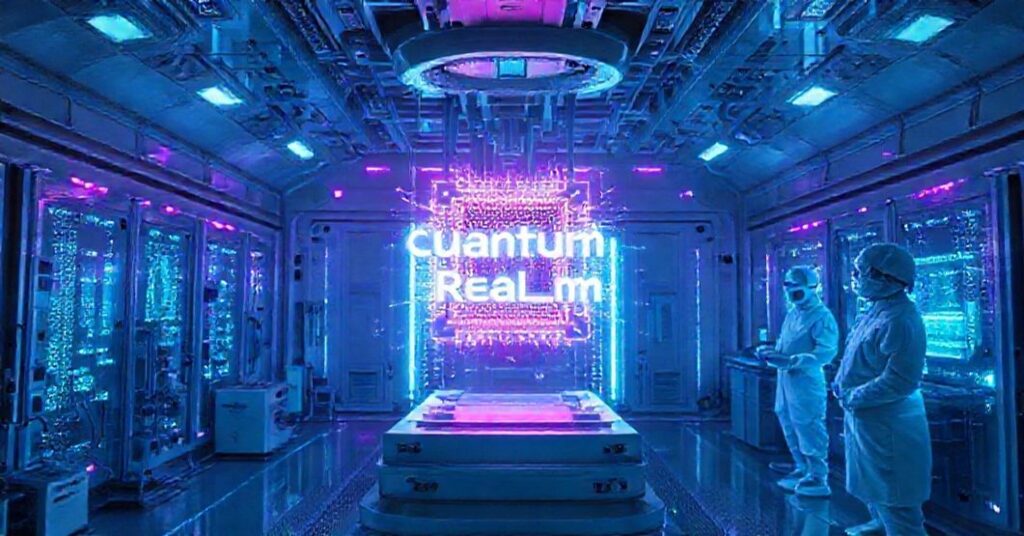

Unveiling the Quantum Realm: A Deep Dive into the Future of Computation
For decades, the silicon-based transistor has been the bedrock of our digital world, powering everything from smartphones to supercomputers. Yet, as classical computing approaches its physical limits, a new paradigm is emerging from the subatomic world: quantum computing. This revolutionary field harnesses the mind-bending principles of quantum mechanics to tackle problems currently intractable for even the most powerful classical machines. It’s not just a faster computer; it’s a fundamentally different way of processing information, promising to reshape industries from medicine to finance and beyond.
The Fundamental Pillars of Quantum Mechanics
At the heart of quantum computing are three bizarre yet powerful phenomena:
- Superposition: Unlike a classical bit, which can be either 0 or 1, a qubit (quantum bit) can exist in a superposition of both states simultaneously. This means a single qubit can represent 0, 1, or any proportion of both at the same time. This capability exponentially increases the amount of information a quantum system can store and process.
- Entanglement: When two or more qubits become entangled, they become intrinsically linked, meaning the state of one qubit instantly influences the state of another, regardless of the distance between them. This correlation is far stronger than any classical connection and is a key resource for quantum algorithms, allowing for complex, interconnected calculations.
- Quantum Tunneling (brief mention): While not a primary computational mechanism, quantum tunneling describes how particles can pass through energy barriers that would be impossible classically. It underscores the probabilistic and counter-intuitive nature of the quantum world that quantum computers exploit.
Classical vs. Quantum: A Paradigm Shift
To truly grasp the power of quantum computing, it’s essential to understand its fundamental differences from classical computing:
- Bits vs. Qubits: Classical computers use bits in definite states (0 or 1). Quantum computers use qubits that leverage superposition, allowing them to exist in multiple states simultaneously, dramatically increasing computational density.
- Logic Gates vs. Quantum Gates: Classical computers manipulate bits using logic gates (AND, OR, NOT). Quantum computers use quantum gates, which are unitary operations that rotate the state of qubits. These gates can entangle qubits and put them into superposition, enabling complex quantum algorithms.
- Processing Power: While classical computers process information sequentially and in parallel, quantum computers can explore many possibilities simultaneously due to superposition and entanglement, leading to exponential speedups for specific problems.
The Quantum Hardware Landscape
Building a stable and scalable quantum computer is an immense engineering challenge. Several competing technologies are vying to become the dominant platform:
- Superconducting Qubits: Utilized by IBM and Google, these qubits are tiny circuits cooled to near absolute zero to eliminate electrical resistance. They are highly controllable but require extreme cryogenic environments.
- Trapped Ions: Companies like IonQ and Honeywell use lasers to suspend and manipulate individual ions. These qubits boast long coherence times (how long a qubit maintains its quantum state) but are challenging to scale.
- Topological Qubits: Microsoft is exploring these more exotic qubits, which are theoretically more resistant to decoherence (loss of quantum properties) due to their inherent topological protection, but they are still in early research stages.
- Photonic Qubits: Using photons (particles of light) as qubits, this approach offers fast operation and potential for room-temperature operation, with companies like Xanadu leading the charge.
Groundbreaking Quantum Algorithms
The true potential of quantum computers lies in their unique algorithms designed to leverage quantum phenomena:
- Shor’s Algorithm: Perhaps the most famous, Shor’s algorithm can factor large numbers exponentially faster than any known classical algorithm. This poses a significant threat to modern public-key cryptography (e.g., RSA), which relies on the difficulty of factoring large prime numbers.
- Grover’s Algorithm: This algorithm can search an unsorted database quadratically faster than classical algorithms. While not an exponential speedup, it can still provide significant advantages for certain search and optimization problems.
- QAOA (Quantum Approximate Optimization Algorithm) & VQE (Variational Quantum Eigensolver): These are hybrid quantum-classical algorithms particularly promising for optimization problems, simulating molecular structures, and materials science. They are designed for current ‘noisy intermediate-scale quantum’ (NISQ) devices.
Transformative Applications Across Industries
Quantum computing promises to revolutionize numerous sectors:
- Drug Discovery & Materials Science: Simulating molecular interactions with unprecedented accuracy could accelerate the development of new drugs, catalysts, and advanced materials.
- Financial Modeling: Optimizing complex portfolios, pricing derivatives more precisely, and improving risk assessment through sophisticated simulations.
- Artificial Intelligence: Enhancing machine learning algorithms (Quantum Machine Learning) for pattern recognition, data analysis, and complex optimization, potentially leading to more powerful AI.
- Cryptography: While threatening current encryption, quantum mechanics also offers solutions. Quantum Key Distribution (QKD) provides theoretically unhackable communication channels.
- Logistics & Optimization: Solving highly complex optimization problems, such as supply chain management, traffic flow, and logistics, more efficiently.
The Road Ahead: Challenges and the NISQ Era
Despite its promise, quantum computing faces significant hurdles:
- Decoherence: Qubits are fragile and easily lose their quantum state due to interaction with their environment. Maintaining coherence long enough for complex calculations is a major challenge.
- Error Correction: Quantum errors are prevalent and difficult to correct without disturbing the delicate quantum states. Robust error correction schemes are crucial for fault-tolerant quantum computers.
- Scalability: Building stable quantum systems with thousands or millions of interconnected, high-quality qubits is an immense engineering feat.
- Cost & Infrastructure: The specialized hardware and extreme environmental controls make quantum computers incredibly expensive and complex to operate.
- Skill Gap: A shortage of quantum physicists, engineers, and programmers capable of designing and utilizing these systems exists.
We are currently in the NISQ (Noisy Intermediate-Scale Quantum) era, where quantum computers have tens to hundreds of qubits but are prone to errors. Researchers are exploring hybrid quantum-classical algorithms that leverage the strengths of both, aiming to demonstrate ‘quantum advantage’ for practical problems. The ultimate goal is to achieve ‘fault-tolerant quantum computing,’ where error rates are low enough for reliable, large-scale computation.
Conclusion
Quantum computing represents a profound shift in our understanding and application of computational power. While still in its infancy, its potential to solve previously unsolvable problems is undeniable. From unlocking new scientific discoveries to revolutionizing industries, the quantum realm beckons with promises of an unimaginable future. As researchers and engineers continue to push the boundaries of what’s possible, we stand on the precipice of a new computational era, one where the bizarre rules of the subatomic world empower us to tackle humanity’s greatest challenges.