
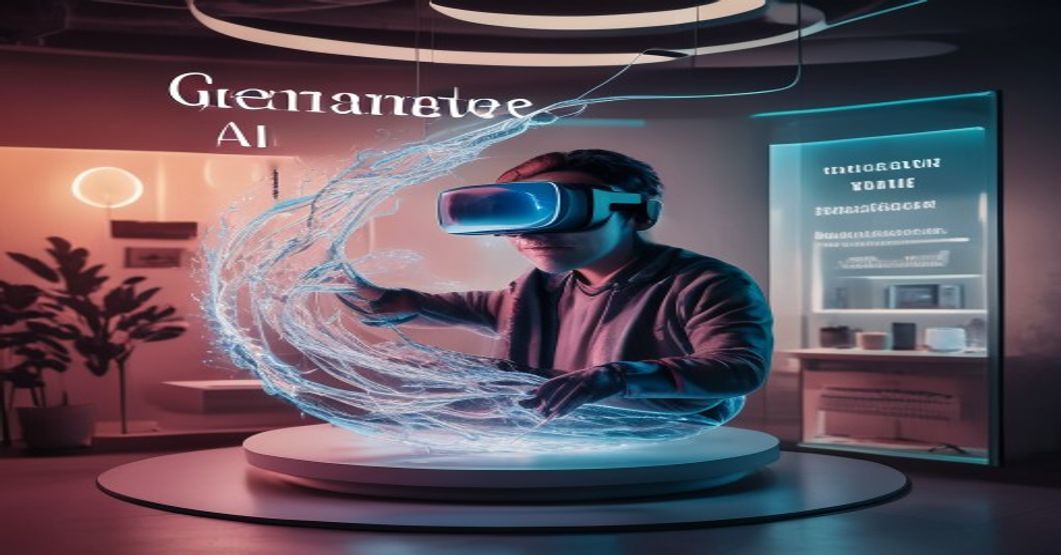
Unleashing Creativity: The Transformative Power of Generative AI
In the rapidly evolving landscape of artificial intelligence, one domain has captured the imagination and attention of researchers, developers, and the public alike: Generative AI. Far beyond mere analysis or classification, generative models are designed to create new data that is similar to the data they were trained on, yet entirely novel. This revolutionary capability is unlocking unprecedented levels of creativity and automation across virtually every industry.
What is Generative AI?
At its core, Generative AI refers to a category of artificial intelligence models capable of producing original content—be it text, images, audio, video, or even code—that resembles human-created output. Unlike discriminative AI, which learns to distinguish between different categories (e.g., Is this a cat or a dog?), generative AI learns the underlying patterns and structures of its input data to generate entirely new examples.
The magic happens when these models identify the statistical regularities and latent variables within vast datasets. Once these patterns are understood, the model can then sample from this learned distribution to synthesize fresh, authentic-looking content. This isn’t just mixing and matching existing pieces; it’s about understanding the ‘rules’ of creation and applying them to generate unique outputs.
How Generative AI Models Work (A Simplified View)
While the field is rich with diverse architectures, some of the most prominent models driving the Generative AI revolution include:
- Generative Adversarial Networks (GANs): Introduced by Ian Goodfellow, GANs consist of two neural networks, a ‘generator’ and a ‘discriminator’, locked in a continuous game. The generator creates new data, attempting to fool the discriminator into believing it’s real. The discriminator tries to distinguish between real and fake data. Both improve over time, with the generator eventually producing highly realistic outputs.
- Variational Autoencoders (VAEs): VAEs learn a compressed, probabilistic representation (latent space) of the input data. They can then sample from this latent space and decode it to generate new data points that share characteristics with the original training data.
- Transformer Models (and Diffusion Models): Transformers, particularly the ‘decoder-only’ variants like those powering OpenAI’s GPT series, excel at sequence generation. They leverage an attention mechanism to understand context and relationships within data, making them exceptionally powerful for text generation. Diffusion models, a newer class, work by progressively adding noise to an image and then learning to reverse that process to generate new images from pure noise.
Key Applications and Use Cases
Generative AI is not confined to research labs; its practical applications are already transforming various sectors:
- Content Creation & Text Generation: From drafting marketing copy, generating articles, summarizing documents, to assisting with creative writing and even coding, models like GPT-3, GPT-4, and Claude are revolutionizing how text-based content is produced. They can generate human-like responses, translate languages, and even write complex essays.
- Image & Art Generation: Tools such as DALL-E, Midjourney, and Stable Diffusion allow users to create stunning, original images and artwork from simple text prompts. This empowers designers, artists, and marketers to rapidly prototype visuals, generate unique illustrations, and explore creative concepts at an unprecedented pace.
- Code Generation & Software Development: AI assistants like GitHub Copilot can suggest code snippets, complete functions, and even generate entire blocks of code based on natural language descriptions or existing code context. This significantly boosts developer productivity and accelerates software development cycles.
- Music & Audio Production: Generative models can compose original musical pieces in various styles, generate realistic voiceovers, and even synthesize new sound effects, opening new avenues for musicians, podcasters, and game developers.
- Product Design & Engineering: In fields like architecture and industrial design, generative AI can explore thousands of design variations that meet specific constraints, optimizing for factors like material use, structural integrity, or aesthetics. This extends to drug discovery and material science, where new molecular structures can be designed.
- Personalization & Customer Experience: Generative AI can tailor marketing messages, product recommendations, and customer service responses to individual users, creating highly personalized and engaging experiences.
Challenges and Ethical Considerations
While the potential of Generative AI is immense, its rapid advancement also presents significant challenges and ethical dilemmas that demand careful consideration:
- Bias and Fairness: Generative models learn from the data they are trained on. If this data contains biases (e.g., racial, gender, cultural), the generated output will reflect and even amplify those biases, leading to unfair or discriminatory results.
- Misinformation and Deepfakes: The ability to create highly realistic images, audio, and video makes generative AI a powerful tool for generating convincing misinformation, propaganda, and deepfakes, posing serious threats to trust and public discourse.
- Intellectual Property and Copyright: The creation of new content based on existing works raises complex questions about intellectual property ownership, fair use, and compensation for original creators whose styles or data might have influenced the models.
- Security Risks: Generative AI can be used to craft highly sophisticated phishing attacks, malware, or social engineering schemes, making it harder to distinguish legitimate from malicious content.
- Environmental Impact: Training large generative models requires immense computational resources and energy, contributing to carbon emissions. Optimizing these models for efficiency is a critical ongoing challenge.
The Future of Generative AI
The trajectory of Generative AI suggests an increasingly integrated role in our digital lives. We can anticipate:
- Increased Accessibility and Democratization: Easier-to-use interfaces and more affordable access will bring generative capabilities to a wider audience, enabling individuals and small businesses to leverage these powerful tools.
- Multimodal Generation: Models capable of seamlessly generating content across different modalities (e.g., creating a video from a text description and an audio prompt) will become more sophisticated.
- Hyper-Personalization at Scale: AI will generate content, products, and experiences that are not just personalized, but uniquely tailored to individual preferences and contexts, almost as if custom-made.
- Enhanced Human-AI Collaboration: Rather than replacing human creativity, Generative AI will increasingly serve as a co-creator, accelerating ideation, refining concepts, and handling repetitive tasks, allowing humans to focus on higher-level strategic and creative thinking.
Conclusion
Generative AI represents a monumental leap in artificial intelligence, fundamentally altering our relationship with technology and creativity. From automating mundane tasks to inspiring entirely new forms of art and innovation, its potential is boundless. However, realizing this potential responsibly requires a concerted effort to address the ethical, societal, and environmental challenges it poses. As we continue to refine these powerful tools, a balanced approach that prioritizes ethical guidelines, transparent development, and human-centric design will be crucial in harnessing Generative AI to truly unleash creativity and build a more innovative future for all.







Leave a Reply