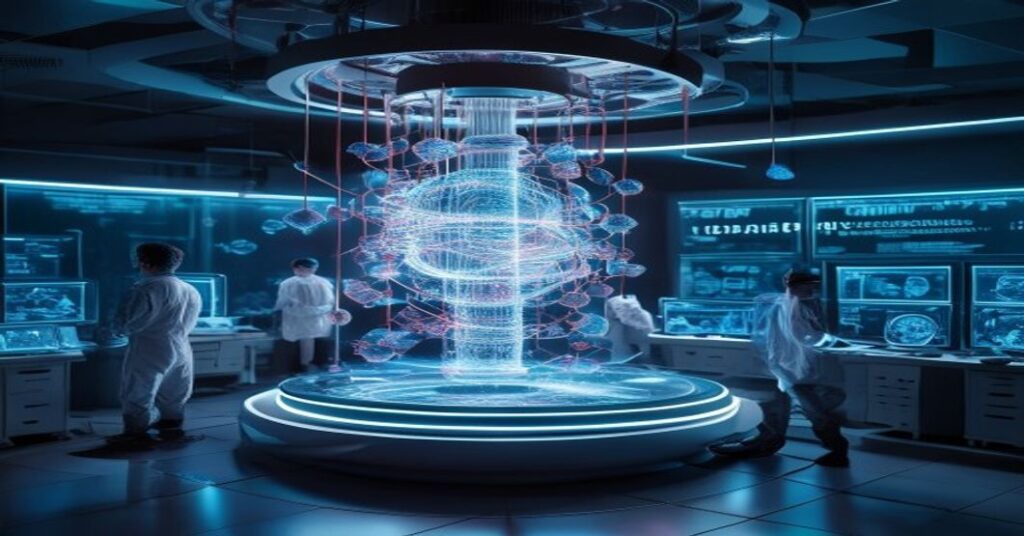

The Quantum Leap: How Quantum Computing is Redefining the Boundaries of Simulation and Optimization
For decades, the relentless march of classical computing has followed Moore’s Law, shrinking transistors and packing more power onto silicon chips. Yet, as we approach the physical limits of this paradigm, a fundamentally different approach is emerging from the laboratories. Quantum computing, once a theoretical curiosity confined to physics textbooks, is now a tangible field of engineering poised to tackle problems that are intractable for even the world’s most powerful supercomputers. This isn’t just about faster computers; it’s about a new kind of computation that operates on the bizarre and counterintuitive principles of quantum mechanics.
Beyond Bits: The Qubit and Its Superpowers
At the heart of this revolution is the quantum bit, or qubit. Unlike a classical bit, which is definitively a 0 or a 1, a qubit can exist in a state of superposition, representing both 0 and 1 simultaneously. This is akin to a spinning coin that is both heads and tails until you stop and look at it. When you have multiple qubits, they can become entangled, a phenomenon where the state of one qubit is intrinsically linked to the state of another, no matter the distance between them. This entanglement allows a quantum computer to process a vast number of possibilities in parallel.
To visualize the power: 2 classical bits can represent one of four states (00, 01, 10, 11) at any one time. 2 qubits in superposition can represent all four states at the same time. This scaling is exponential. With 300 perfectly entangled qubits, you could theoretically represent more states than there are atoms in the known universe—a level of parallelism that is simply unattainable classically.
The Hardware Race: Trapped Ions, Superconductors, and Beyond
Building a stable, scalable quantum computer is one of the greatest engineering challenges of our time. Qubits are notoriously fragile, easily losing their quantum state (a process called decoherence) due to minute vibrations, temperature fluctuations, or electromagnetic interference. Major players are pursuing different technological paths to overcome this:
- Superconducting Qubits (Google, IBM): These use supercooled circuits that exhibit quantum effects. They are currently the most advanced in terms of qubit count and are the basis for noisy intermediate-scale quantum (NISQ) devices available via the cloud.
- Trapped Ions (IonQ, Honeywell): Individual atoms are suspended in electromagnetic fields and manipulated with lasers. They boast exceptionally long coherence times and high-fidelity operations, though scaling to thousands of ions presents challenges.
- Topological Qubits (Microsoft): A more speculative but promising approach that encodes information in the global properties of matter, making them inherently more robust against local noise.
- Photonic Qubits (PsiQuantum, Xanadu): Using particles of light (photons) to carry quantum information, which could be advantageous for building quantum networks and operating at room temperature.
Killer Apps: Where Quantum Will Make Its Mark First
The full potential of fault-tolerant, error-corrected quantum computers is decades away. However, the current NISQ era is already yielding practical insights. The first “killer applications” are likely to emerge in specific domains:
1. Quantum Simulation
The most natural application. To simulate a quantum system (like a complex molecule for drug discovery or a novel material for batteries), a classical computer must perform exponentially difficult calculations. A quantum computer, operating by the same quantum rules, can simulate these systems natively. This could revolutionize:
- Drug Discovery: Modeling the interaction of proteins and drug candidates at the quantum level to accelerate the development of new medicines.
- Materials Science: Designing more efficient catalysts for fertilizer production, better superconductors, or next-generation solar cell materials.
2. Optimization
Many business and logistical problems—from supply chain routing and financial portfolio optimization to machine learning training—are, at their core, about finding the best solution from a near-infinite set of possibilities. Quantum algorithms like the Quantum Approximate Optimization Algorithm (QAOA) are designed to navigate these complex landscapes more efficiently than classical heuristics.
3. Cryptography and Security
This is a double-edged sword. Shor’s algorithm, when run on a sufficiently powerful quantum computer, could break widely used public-key encryption (RSA, ECC). This has sparked the global field of post-quantum cryptography (PQC)—developing new classical encryption algorithms that are resistant to quantum attacks. Simultaneously, quantum key distribution (QKD) uses quantum principles to create theoretically unhackable communication channels.
The Road Ahead: Challenges and the Hybrid Computing Model
The path to a commercially useful, fault-tolerant quantum computer is steep. Key challenges include:
- Error Correction: Mitigating noise requires dedicating thousands of physical “noisy” qubits to create a single, reliable “logical” qubit.
- Scalability: Building and controlling systems of millions of qubits with extreme precision.
- Algorithms: Developing novel algorithms that can deliver advantage on imperfect, near-term hardware.
In the interim, the most promising model is hybrid quantum-classical computing. Here, a quantum processor acts as a specialized co-processor for specific, quantum-friendly sub-tasks within a larger classical workflow. Variational algorithms, where a classical optimizer tunes parameters for a quantum circuit, are a prime example of this symbiotic relationship.
Conclusion: A Paradigm in Progress
Quantum computing is not a replacement for classical computing; it is a powerful complement for a specific, universe-altering class of problems. We are in the era of exploration, where researchers, developers, and enterprises are learning to program these exotic machines and identify the problems where they will provide a decisive advantage. The journey from lab to data center is underway, and its success will redefine what is computationally possible, unlocking new frontiers in science, medicine, and industry. The quantum leap is no longer a metaphor—it’s an engineering roadmap.