
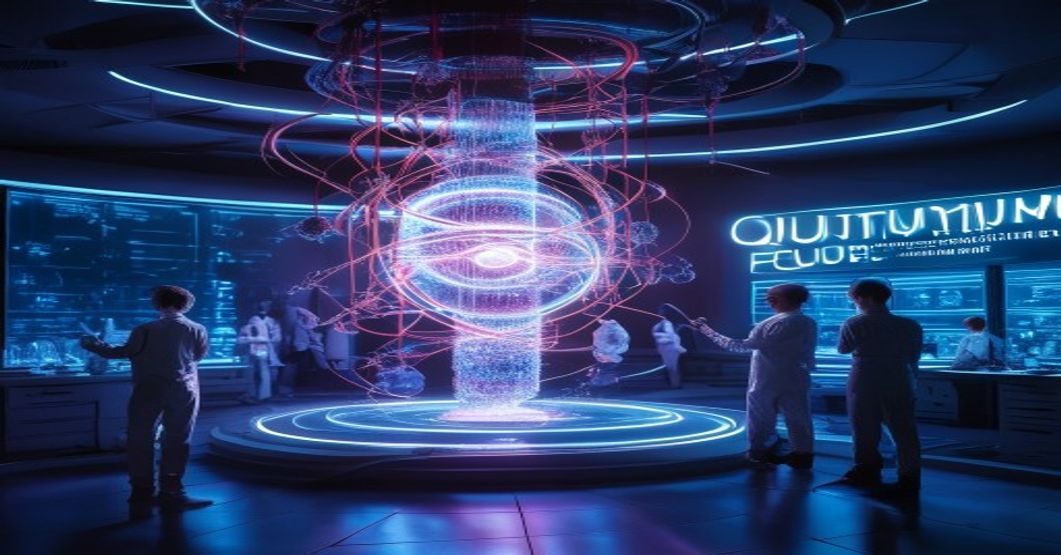
Quantum Leaps: Unraveling the Future with Quantum Computing
For decades, classical computers have been the bedrock of our digital world, processing information using bits that represent either a 0 or a 1. But as we push the boundaries of computational challenges – from discovering new drugs to breaking complex encryption – a new paradigm is emerging: Quantum Computing. Far from an incremental upgrade, quantum computing promises a fundamental shift in how we process information, leveraging the bizarre and counter-intuitive laws of quantum mechanics to tackle problems currently intractable for even the most powerful supercomputers.
The Quantum Advantage: Beyond Bits to Qubits
The core difference between classical and quantum computing lies in their fundamental unit of information:
- Classical Bits: A classical bit can exist in one of two definite states: 0 or 1.
- Quantum Qubits: A quantum bit, or qubit, can exist in a superposition of both 0 and 1 simultaneously. This means a single qubit can represent a combination of states, dramatically increasing the amount of information it can store and process compared to a classical bit.
Key Principles Driving Quantum Power:
- Superposition: Imagine a coin spinning in the air – it’s neither heads nor tails until it lands. A qubit in superposition is like that spinning coin, existing in multiple states at once. It’s only when measured that it collapses into a definite 0 or 1. This property allows quantum computers to perform computations on many values simultaneously.
- Entanglement: This is arguably the most mysterious and powerful quantum phenomenon. When two or more qubits become entangled, they become intrinsically linked, regardless of the physical distance separating them. Measuring the state of one entangled qubit instantaneously influences the state of the other(s). This allows quantum computers to create highly correlated systems where the state of one qubit provides information about all other entangled qubits, enabling exponential computational speedups for certain problems.
- Interference: Quantum computers manipulate qubits using quantum gates (analogous to logic gates in classical computers). These gates harness quantum interference patterns, where probabilities of different outcomes can constructively (amplify) or destructively (cancel out) interfere, allowing the computer to home in on the correct solution by amplifying correct paths and canceling out incorrect ones.
Transformative Applications: Where Quantum Shines
The unique capabilities of quantum computing position it to revolutionize a multitude of fields:
- Drug Discovery and Materials Science: Simulating molecular interactions with high precision is computationally intensive. Quantum computers can model complex molecules and chemical reactions at the atomic level, accelerating the discovery of new drugs, catalysts, and advanced materials with novel properties (e.g., superconductors, high-efficiency solar cells).
- Cryptography: Shor’s algorithm, a quantum algorithm, can efficiently factor large numbers, a task that underpins modern public-key encryption (like RSA). This poses a significant threat to current cybersecurity protocols, driving research into post-quantum cryptography. Conversely, quantum mechanics also offers quantum-safe encryption methods like Quantum Key Distribution (QKD).
- Optimization Problems: Many real-world problems involve finding the best solution among an astronomically large number of possibilities (e.g., logistics, financial modeling, traffic flow, airline scheduling). Quantum algorithms like Grover’s algorithm can significantly speed up the search for optimal solutions.
- Artificial Intelligence and Machine Learning: Quantum machine learning (QML) can potentially accelerate training times for complex models, enhance pattern recognition, and enable new forms of AI that leverage quantum states for data representation and processing, leading to breakthroughs in areas like image recognition, natural language processing, and deep learning.
- Financial Modeling: Quantum computers can perform more accurate and faster risk analysis, portfolio optimization, and fraud detection by simulating complex financial markets and interactions.
The Road Ahead: Challenges and Progress
Despite its immense promise, quantum computing is still in its nascent stages. Significant challenges remain:
- Decoherence: Qubits are incredibly fragile and easily lose their quantum properties (decohere) when they interact with their environment. Maintaining quantum states for long enough to perform complex computations requires extreme isolation, often at ultra-low temperatures.
- Error Correction: Quantum errors are prevalent and difficult to correct without disturbing the qubit’s delicate state. Developing robust quantum error correction codes is a critical area of research.
- Hardware Development: Building stable, scalable, and high-fidelity quantum computers is an engineering marvel. Various approaches are being explored, including superconducting qubits, trapped ions, topological qubits, and photonic qubits, each with its own advantages and challenges.
- Algorithm Development: While a few groundbreaking algorithms exist (Shor’s, Grover’s), the field of quantum algorithm design is still young, requiring new ways of thinking about computation.
- Programming and Accessibility: Programming quantum computers requires a deep understanding of quantum mechanics, making it a specialized skill. Efforts are underway to develop higher-level programming languages and development kits to make quantum computing more accessible.
Nevertheless, progress is rapid. Companies like IBM, Google, Microsoft, and numerous startups are investing heavily in quantum research and development, building increasingly powerful quantum processors and making them available through cloud platforms. Hybrid classical-quantum algorithms are emerging as a practical intermediate step, combining the strengths of both computational paradigms.
Conclusion
Quantum computing represents a profound paradigm shift, not merely an evolution of classical computing. While still in its infancy, its potential to address some of humanity’s most complex challenges is undeniable. As researchers and engineers continue to overcome the formidable obstacles, we stand on the precipice of a quantum era, where the once-impenetrable mysteries of the universe might finally yield to the power of quantum mechanics, unraveling a future brimming with unprecedented technological advancements.










Leave a Reply