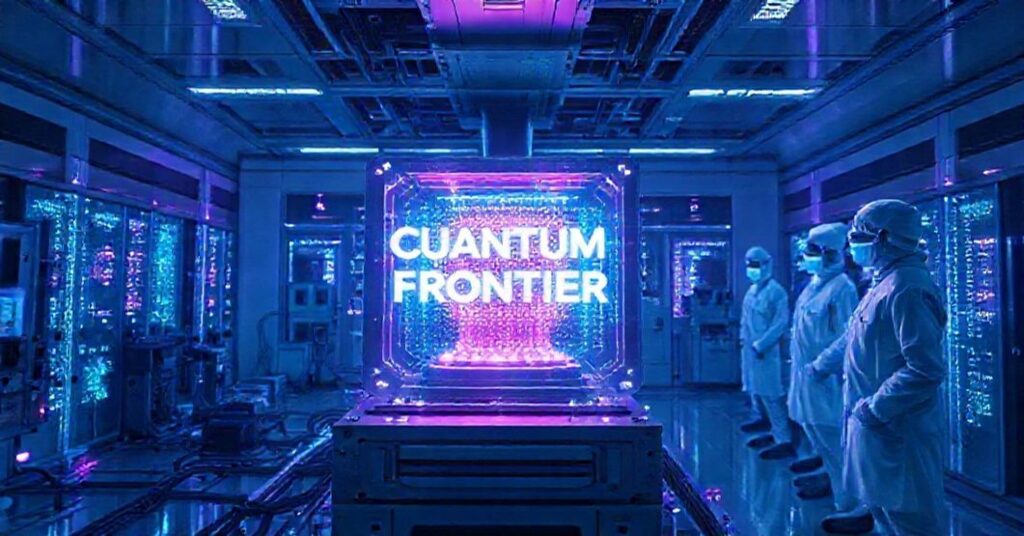

Quantum Computing Unveiled: Beyond Bits and Towards a New Computational Frontier
In the vast landscape of technological evolution, certain advancements signal a paradigm shift, promising to redefine the very limits of what’s possible. Quantum computing is undoubtedly one such frontier. Far from being an incremental improvement on classical computers, quantum machines harness the bizarre and counter-intuitive principles of quantum mechanics to tackle problems that are currently intractable for even the most powerful supercomputers. This isn’t just a faster computer; it’s a fundamentally different way of processing information.
The Fundamental Difference: Bits vs. Qubits
To grasp the power of quantum computing, one must first understand how it diverges from traditional computation. Classical computers operate using bits, which are binary digits representing either a 0 or a 1. These bits are the fundamental building blocks of all digital information, forming the basis of logic gates and complex algorithms.
- Classical Bits: A bit is always in a definite state, either 0 or 1. Think of it like a light switch that is either definitively ON or OFF.
- Quantum Qubits: Quantum computers, however, leverage qubits (quantum bits). Unlike classical bits, qubits can exist in a superposition of both 0 and 1 simultaneously. This remarkable property allows a single qubit to hold significantly more information than a classical bit. Furthermore, multiple qubits can become entangled, meaning their fates are linked, and the state of one instantly influences the state of another, regardless of distance.
Key Principles of Quantum Mechanics Driving Quantum Computing
The magic of quantum computing stems directly from three core phenomena of quantum mechanics:
Superposition
Imagine a spinning coin. Before it lands, it’s neither heads nor tails; it’s in a state of superposition. Similarly, a qubit can be 0, 1, or any combination of 0 and 1 at the same time. This means that a system of ‘n’ qubits can represent 2^n possible states simultaneously. For example, two qubits can simultaneously represent (00, 01, 10, 11), exponentially increasing the computational space. This parallel processing capability is what gives quantum computers their immense potential.
Entanglement
Entanglement is a phenomenon where two or more qubits become inextricably linked, even when physically separated. If you measure the state of one entangled qubit, you instantly know the state of its partner, no matter how far apart they are. Einstein famously called this “spooky action at a distance.” In quantum computing, entanglement allows for complex, correlated operations across multiple qubits, enabling algorithms that would be impossible with classical bits.
Quantum Interference
Much like waves in water, quantum states can interfere with each other. In quantum computing, this principle is used to amplify the probabilities of correct answers and diminish the probabilities of incorrect ones. Quantum algorithms are carefully designed to make “right” computational paths interfere constructively and “wrong” paths interfere destructively, guiding the system towards the desired solution.
Architectures and Technologies: Building Quantum Computers
Building a stable and scalable quantum computer is an immense engineering challenge. Various physical implementations are being explored, each with its own advantages and hurdles:
- Superconducting Qubits: Used by IBM and Google, these qubits are tiny circuits cooled to near absolute zero to maintain their quantum states. They are highly scalable but extremely sensitive to environmental noise.
- Trapped Ion Qubits: Companies like IonQ and Honeywell use electromagnetic fields to suspend individual ions (charged atoms) in a vacuum. Lasers are then used to manipulate their quantum states. These qubits boast high coherence times and gate fidelities.
- Photonic Qubits: Utilizing photons (particles of light) as qubits, this approach promises robustness against decoherence, as photons interact minimally with their environment. However, controlling and entangling photons efficiently remains a challenge.
- Topological Qubits: Microsoft is heavily investing in this approach, which seeks to encode quantum information in “quasiparticles” that are topologically protected, making them inherently more resistant to decoherence.
Current Applications and Future Potential
While still in its nascent stages, quantum computing holds the promise of revolutionizing numerous fields:
- Drug Discovery and Materials Science: Simulating molecular interactions at the quantum level could accelerate the discovery of new drugs, catalysts, and advanced materials with unprecedented properties.
- Financial Modeling: Optimizing complex financial portfolios, risk analysis, and fraud detection could see significant improvements.
- Optimization Problems: From logistics and supply chain management to traffic flow and resource allocation, quantum computers could find optimal solutions to problems with an immense number of variables.
- Cryptography: Algorithms like Shor’s could break many of the encryption methods currently used to secure online communications, while Grover’s algorithm could significantly speed up database searches. This also necessitates the development of quantum-safe cryptography.
- Artificial Intelligence and Machine Learning: Enhancing machine learning algorithms for pattern recognition, data analysis, and complex optimization, potentially leading to truly intelligent AI.
Challenges and the Path Forward
Despite its immense promise, quantum computing faces significant hurdles:
- Decoherence: Qubits are incredibly fragile and lose their quantum properties (decohere) when they interact with their environment. Maintaining coherence for long enough to perform complex computations is a major challenge.
- Error Correction: Quantum errors are prevalent and difficult to correct without disturbing the very quantum states they aim to preserve. Robust quantum error correction is crucial for fault-tolerant quantum computers.
- Scalability: Building quantum computers with a large number of stable, high-quality qubits is an engineering marvel. Current machines have dozens, perhaps a few hundred, qubits, far from the millions or billions needed for truly groundbreaking applications.
- Cost and Accessibility: The technology is incredibly expensive and requires highly specialized expertise, limiting its accessibility to a few research institutions and large corporations.
- Algorithm Development: Developing effective quantum algorithms that can leverage the unique capabilities of quantum computers is a specialized and ongoing area of research.
The Quantum Future: A New Era of Computation
Quantum computing is not intended to replace classical computers but rather to complement them, tackling specific classes of problems that are beyond the reach of conventional machines. We are entering the NISQ era (Noisy Intermediate-Scale Quantum), where devices have enough qubits to be interesting but are still prone to errors. As quantum hardware matures and error correction techniques improve, the potential for breakthroughs across science, engineering, and industry is profound.
The journey into the quantum realm is just beginning, but its implications are set to reshape our technological landscape in ways we are only just starting to imagine. Prepare for a future where the impossible becomes computationally possible.