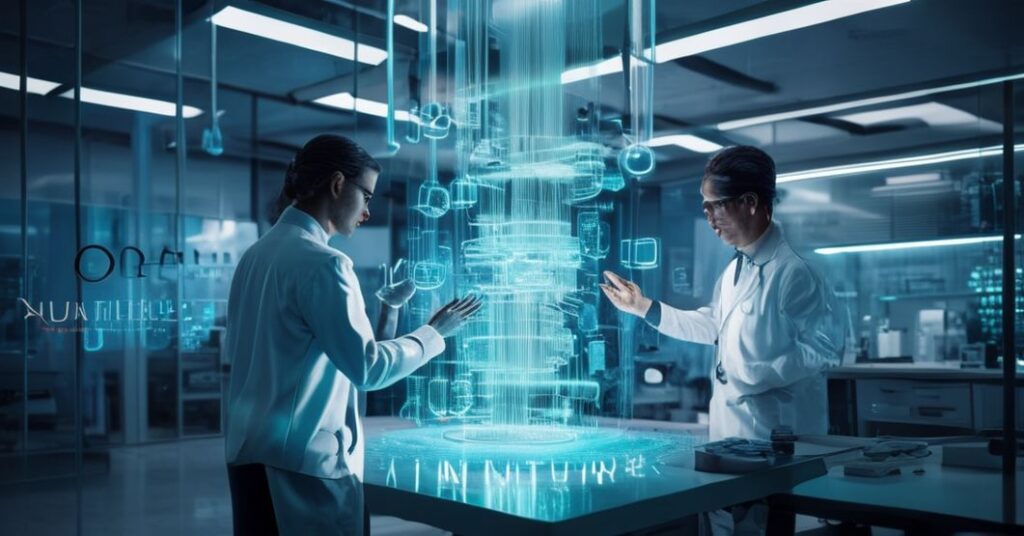

Demystifying Quantum Computing: Principles, Potential, and Pathways
In the relentless march of technological progress, certain advancements stand out as true game-changers, promising to reshape our understanding of what’s possible. Quantum computing is undoubtedly one such frontier. Far from merely a faster version of classical computers, quantum computing harnesses the mind-bending principles of quantum mechanics to tackle problems currently intractable for even the most powerful supercomputers. This article will delve into the core concepts that define this revolutionary field, explore its potential applications, and examine the challenges that lie on the path to its widespread adoption.
Beyond Bits: The Quantum Leap with Qubits
Our current digital world is built upon classical bits, which represent information as either a 0 or a 1. This binary state is the foundation of all computation we know. Quantum computing, however, introduces the concept of the qubit (quantum bit).
- Superposition: Unlike a classical bit, a qubit can exist in a superposition of both 0 and 1 simultaneously. Imagine a coin spinning in the air – it’s neither heads nor tails until it lands. A qubit can be thought of as existing in a combination of states until it is measured. This ability to represent multiple states at once is what gives quantum computers their immense parallel processing power.
- Entanglement: Perhaps the most mysterious and powerful aspect of quantum mechanics, entanglement occurs when two or more qubits become inextricably linked. The state of one entangled qubit instantaneously affects the state of the other, regardless of the distance between them. This phenomenon allows for exponentially larger computational spaces, enabling complex calculations that would be impossible with classical bits.
These two properties – superposition and entanglement – are the bedrock upon which quantum algorithms are built, allowing quantum computers to explore vast computational landscapes simultaneously.
Groundbreaking Algorithms: Solving the Unsolvable
The true power of quantum computing lies in its unique algorithms, designed to exploit quantum phenomena. Here are a few prominent examples:
- Shor’s Algorithm: Developed by Peter Shor, this algorithm can factor large numbers into their prime components exponentially faster than any known classical algorithm. Its implications for current public-key cryptography (which relies on the difficulty of factoring large numbers) are profound, as it could theoretically break widely used encryption methods like RSA.
- Grover’s Algorithm: For searching an unstructured database, Grover’s algorithm offers a quadratic speedup over classical algorithms. While not an exponential speedup, it significantly reduces the number of steps required to find a target item among N possibilities, making it highly valuable for certain search and optimization problems.
- Quantum Approximate Optimization Algorithm (QAOA) & Variational Quantum Eigensolver (VQE): These are examples of “variational” quantum algorithms, which leverage a combination of classical and quantum computation. They are particularly promising for solving optimization problems and simulating molecular structures, offering a pathway to tackling real-world problems even with current noisy intermediate-scale quantum (NISQ) devices.
The Hardware Frontier: Building Quantum Machines
Translating quantum principles into physical hardware is an enormous engineering challenge. Several promising approaches are being pursued globally:
- Superconducting Qubits: These are tiny circuits operated at temperatures near absolute zero to eliminate electrical resistance and maintain quantum states. Giants like IBM and Google are at the forefront of this technology.
- Trapped Ions: Individual ions (charged atoms) are suspended in electromagnetic fields and manipulated with lasers. Companies like IonQ are making significant strides with this approach, known for its high qubit quality and connectivity.
- Photonic Qubits: Using photons (particles of light) as qubits offers the advantage of operating at room temperature and ease of integration with fiber optics. However, interaction between photons is difficult, posing challenges for building complex quantum gates.
- Topological Qubits: Still largely theoretical, this approach aims to encode information in the topological properties of quasiparticles, offering inherent robustness against decoherence – a major hurdle in quantum computing.
Transformative Applications: Where Quantum Computing Will Shine
The potential applications of quantum computing span a vast array of industries, promising to unlock solutions to problems previously thought unsolvable:
- Drug Discovery & Materials Science: Quantum computers can simulate molecular interactions with unprecedented accuracy, accelerating the discovery of new drugs, designing novel materials with specific properties, and optimizing chemical processes.
- Financial Modeling: Complex financial models, risk assessment, portfolio optimization, and fraud detection can benefit from quantum algorithms that can process vast datasets and explore intricate correlations far more efficiently.
- Advanced Cryptography: While Shor’s algorithm poses a threat to current encryption, quantum computers can also be used to develop “post-quantum cryptography” – new encryption methods designed to be resistant even to quantum attacks.
- Artificial Intelligence & Machine Learning: Quantum machine learning algorithms could enhance pattern recognition, optimize neural networks, and process larger, more complex datasets, leading to breakthroughs in AI capabilities.
- Optimization Problems: From logistics and supply chain management to traffic flow and airline scheduling, many real-world problems are combinatorial optimization challenges. Quantum computers could find optimal solutions much faster than classical methods.
Challenges and the Road Ahead
Despite its incredible promise, quantum computing faces significant hurdles:
- Decoherence: Qubits are extremely fragile and easily lose their quantum state due to interaction with their environment. Maintaining coherence for long enough to perform complex calculations is a major challenge.
- Error Correction: Quantum errors are prevalent and complex. Developing robust quantum error correction techniques that can reliably protect qubits and calculations is critical but computationally intensive.
- Scalability: Building quantum computers with thousands or millions of stable, interconnected qubits is a monumental engineering feat. Current devices are in the “noisy intermediate-scale quantum” (NISQ) era, with tens to hundreds of qubits and limited error correction.
- Cost and Infrastructure: The specialized hardware, extreme cooling requirements, and intricate control systems make quantum computers incredibly expensive to build and operate.
- Skill Gap: There is a significant shortage of experts proficient in quantum mechanics, quantum algorithms, and quantum software development.
The future of quantum computing is likely to involve a hybrid approach, where classical computers handle parts of a problem and offload specific, computationally intensive tasks to quantum processors. While a universal, fault-tolerant quantum computer is still decades away, the NISQ era is already yielding valuable insights and demonstrating quantum advantage for specific problems. Investment in research, education, and infrastructure is rapidly accelerating, pushing the boundaries of what was once considered science fiction closer to reality.
Conclusion
Quantum computing represents a paradigm shift in computation, offering a glimpse into a future where today’s insurmountable problems become solvable. By harnessing the peculiar rules of quantum mechanics – superposition and entanglement – it promises to revolutionize industries from medicine to finance, AI to cryptography. While the journey is long and fraught with significant technical challenges, the progress being made is undeniable. As researchers continue to push the boundaries of quantum hardware and software, we are on the precipice of a new era, one where quantum computers unlock capabilities that will redefine the limits of human innovation.