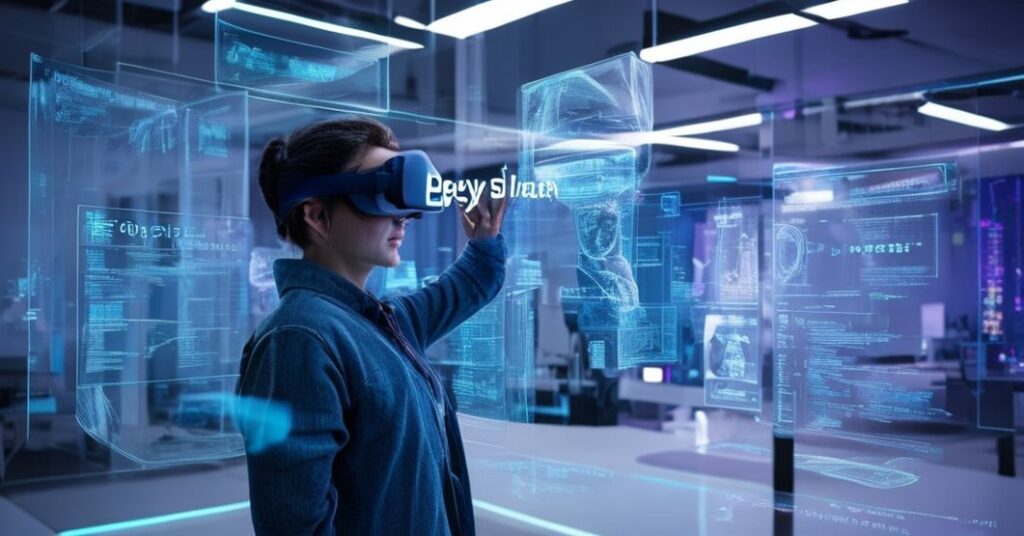

Beyond Screens: Exploring the Immersive Potential of AR, VR, and the Metaverse
For decades, our interaction with digital information has been largely confined to flat screens. Desktops, laptops, and smartphones have served as windows to the internet, applications, and entertainment. However, a new paradigm is rapidly emerging, promising to shatter these conventional barriers: Augmented Reality (AR), Virtual Reality (VR), and the grand vision of the Metaverse. These technologies are not merely incremental upgrades; they represent a fundamental shift in how we perceive, interact with, and even inhabit digital spaces, promising a future where the digital and physical worlds blend seamlessly.
This article dives deep into the distinct yet converging worlds of AR, VR, and the Metaverse, exploring their underlying technologies, transformative applications, and the challenges that must be overcome to fully realize their immense potential.
The Core Technologies: AR vs. VR
While often grouped, Augmented Reality and Virtual Reality offer fundamentally different immersive experiences:
Virtual Reality (VR): Escaping to New Worlds
VR completely immerses users in a simulated environment, typically by replacing their view of the real world with a digital one. Users wear headsets that block out physical surroundings and display computer-generated images, often accompanied by spatial audio and haptic feedback to enhance the sense of presence.
- Complete Immersion: Users are fully enveloped in a digital world, cut off from their physical environment.
- Hardware: Requires dedicated VR headsets (e.g., Meta Quest, Valve Index, PlayStation VR).
- Applications: Gaming, virtual training simulations, remote collaboration in digital spaces, virtual tourism, therapy.
- Key Characteristic: Replacement of reality.
Augmented Reality (AR): Enhancing Our Reality
AR overlays digital information onto the real world, allowing users to see and interact with both simultaneously. Instead of replacing reality, AR enhances it with contextual digital content, often delivered through smartphone screens, tablets, or specialized AR glasses.
- Enhanced Reality: Digital elements are superimposed onto the user’s view of the real world.
- Hardware: Often uses smartphones/tablets, but dedicated AR glasses (e.g., Microsoft HoloLens, Magic Leap) are emerging.
- Applications: Interactive advertising, navigation, virtual try-on for retail, industrial maintenance, education with 3D models.
- Key Characteristic: Augmentation of reality.
Diving into the Metaverse: A Digital Frontier
The Metaverse is a much broader concept, often described as a persistent, interconnected, and interoperable network of 3D virtual worlds where users can interact with each other, digital objects, and AI agents in real-time. It’s envisioned as the next iteration of the internet, moving from a two-dimensional browsing experience to a three-dimensional, embodied one.
Defining Characteristics of the Metaverse:
- Persistence: Unlike a game session that ends, the Metaverse continues to exist and evolve even when you’re not in it.
- Interoperability: Users can seamlessly move between different virtual spaces, carrying their digital assets (avatars, items, data) with them.
- Real-time Interaction: All interactions occur synchronously, fostering a sense of shared presence.
- Economic System: A fully functioning digital economy, often leveraging blockchain for digital ownership and currency.
- User-Generated Content: Users are not just consumers but active creators of content and experiences within the Metaverse.
The Metaverse isn’t a single product or platform; it’s an evolving ecosystem that draws heavily on AR, VR, AI, blockchain, and advanced networking to create its rich, immersive environments.
Transformative Applications Across Industries
The combined power of AR, VR, and the emerging Metaverse promises to revolutionize various sectors:
Entertainment & Gaming
- Immersive Gaming: VR titles offer unparalleled immersion, while AR games blend digital play with the physical world.
- Virtual Concerts & Events: Artists and performers are hosting concerts and festivals in virtual worlds, accessible globally.
- Interactive Storytelling: New forms of narrative that allow users to actively participate in the story.
Education & Training
- Virtual Classrooms & Labs: Students can conduct experiments, dissect virtual organs, or explore historical sites without physical constraints.
- Skills Training: VR simulations for surgeons, pilots, and engineers offer safe, repeatable, and realistic training scenarios.
- Interactive Learning: AR overlays can provide real-time information or 3D models directly in a student’s environment.
Enterprise & Collaboration
- Virtual Workspaces: Remote teams can meet in VR, sharing 3D models and collaborating as if in the same room.
- Digital Twins: AR/VR allows engineers to inspect and interact with virtual replicas of physical assets (factories, machinery), aiding design, maintenance, and monitoring.
- Remote Assistance: AR tools enable experts to guide on-site technicians visually, superimposing instructions onto their view.
Retail & E-commerce
- Virtual Try-Ons: AR apps allow customers to try on clothes, makeup, or even place furniture in their homes before buying.
- Immersive Shopping: Brands are creating virtual stores in the Metaverse, offering unique, interactive shopping experiences.
- Product Visualization: AR helps consumers visualize complex products in 3D, enhancing purchasing confidence.
Key Technologies Powering the Immersive Future
The realization of a fully functional Metaverse relies on advancements across multiple technological domains:
- Hardware: High-resolution VR headsets with wider fields of view, lighter and more powerful AR glasses, advanced haptic feedback systems, and motion tracking sensors are crucial for realistic immersion.
- Software & Development Kits: Powerful 3D engines (Unity, Unreal Engine), sophisticated rendering pipelines, AI for realistic NPC behavior and content generation, and robust SDKs are essential for creating rich virtual experiences. Computer vision and spatial computing enable AR devices to understand and interact with the real world.
- Networking: Ultra-low latency, high-bandwidth connectivity (like 5G and future 6G) is vital to support real-time interactions, massive multiplayer environments, and streaming of complex 3D data without lag.
- Blockchain & Decentralization: Blockchain technology enables verifiable digital ownership (NFTs for virtual assets), secure digital identities, and decentralized governance within Metaverse platforms, fostering trust and interoperability in virtual economies.
- Cloud Computing: Massive computational power and storage in the cloud are necessary to render complex virtual worlds, process real-time data from countless users, and deliver experiences on demand.
Challenges and Considerations
Despite the promise, the journey to a fully realized immersive future is fraught with challenges:
- Interoperability & Open Standards: A truly open Metaverse requires seamless transfer of avatars, items, and identities between different platforms. Establishing common standards and protocols is a monumental task.
- Privacy & Security: Collecting vast amounts of personal data (biometrics, movement patterns, emotional responses) in immersive environments raises significant privacy concerns. Ensuring data security and preventing misuse is paramount.
- Accessibility & Inclusivity: The high cost of advanced hardware, potential for motion sickness, and the need for diverse representation in virtual worlds are significant barriers to widespread adoption and equitable access.
- Ethical Concerns: Issues like digital addiction, misinformation, cyberbullying, and the blurring lines between real and virtual identities require careful consideration and ethical frameworks.
- Computational Demands: Rendering realistic, persistent 3D worlds for millions of users simultaneously requires unprecedented computing power and energy, posing challenges for infrastructure and sustainability.
The Road Ahead: What to Expect
The Metaverse won’t arrive overnight as a singular, monolithic entity. Instead, it will likely evolve gradually, built upon existing AR/VR technologies and gaming platforms. We can anticipate increasing sophistication in hardware, more intuitive interaction methods, and a growing number of interoperable virtual spaces. Early adopters and innovators are already laying the groundwork, experimenting with decentralized platforms and creating immersive experiences that hint at the future.
As the digital and physical worlds continue to converge, AR, VR, and the Metaverse promise to reshape industries, redefine human interaction, and unlock new frontiers of creativity and commerce. Navigating the technical, ethical, and societal challenges will be crucial, but the potential rewards of a truly immersive digital future are immense.