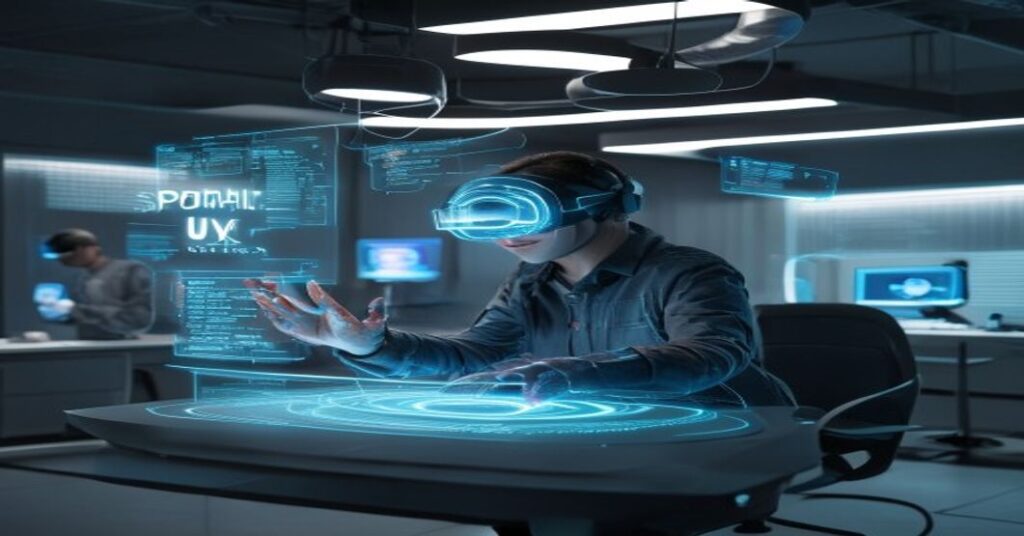

Developing for Spatial Computing: Crafting Immersive Experiences Beyond the Screen
The digital world, traditionally confined to our flat screens, is rapidly breaking free. We’re on the cusp of a new computing paradigm known as Spatial Computing – an evolution that seamlessly blends digital information with our physical environments. This isn’t merely about augmented reality (AR) or virtual reality (VR); it’s about building applications that understand and interact with the three-dimensional world around us, creating deeply immersive and context-aware experiences.
What is Spatial Computing?
At its core, Spatial Computing refers to technology that allows computers to operate in and understand our physical space, integrating digital content directly into the real world. Unlike traditional computing, which treats the physical environment as a background, spatial computing makes it a fundamental input and output medium. It encompasses and extends concepts from AR, VR, and mixed reality (MR), collectively known as Extended Reality (XR), by focusing on three key pillars:
- Perception: Devices use sensors (cameras, LiDAR, depth sensors) to map and understand the environment, recognizing objects, surfaces, and human movements.
- Interaction: Users interact with digital content naturally, using gestures, gaze, voice, and even physical objects, rather than relying solely on mice and keyboards.
- Persistence: Digital objects can remain anchored in specific locations in the physical world over time, allowing for shared experiences and ongoing interactions.
Think of architectural walkthroughs where digital models overlay real construction sites, or educational applications where interactive 3D models populate your living room – these are glimpses into the spatial computing future.
Core Principles of Spatial Application Design
Developing for spatial computing demands a shift in mindset from traditional screen-based applications. Here are fundamental principles to guide the design process:
-
User Experience (UX) in 3D: Comfort, Intuition, and Presence:
The priority shifts from pixel-perfect UI to human comfort and intuition. Applications must minimize motion sickness, provide natural interaction methods, and foster a sense of ‘presence’ – the feeling of truly being in the digital or mixed environment. This involves careful consideration of field of view, refresh rates, and the realism of digital objects.
-
Human-Computer Interaction (HCI) Beyond the Mouse:
Input methods are diverse and multimodal: natural hand gestures, eye tracking, voice commands, and physical movement. Designers must craft interfaces that feel intuitive and responsive, mirroring real-world interactions as much as possible to reduce cognitive load.
-
Contextual Awareness and Environment Understanding:
Spatial applications leverage environmental data (lighting, room geometry, object identification) to make digital content contextually relevant. This allows for dynamic adaptations, such as digital lights casting realistic shadows or virtual characters navigating around real-world obstacles.
-
Performance Optimization: Latency, Rendering, and Power:
Maintaining high frame rates and low latency is crucial to prevent discomfort and maintain immersion. This requires highly optimized 3D rendering, efficient use of computing resources, and careful management of battery life, especially for mobile and standalone AR/VR devices.
Key Technological Enablers
The rise of spatial computing is fueled by advancements across various tech domains:
-
Advanced Hardware:
From high-resolution AR glasses (e.g., Apple Vision Pro, Meta Quest series) and powerful VR headsets to sophisticated depth sensors (LiDAR, structured light), the hardware foundation provides the necessary computational and sensory capabilities.
-
Software Frameworks & SDKs:
Game engines like Unity and Unreal Engine have become de facto standards for XR development, offering robust 3D rendering, physics, and interaction tools. Platform-specific SDKs like Apple’s ARKit, Google’s ARCore, and the open standard OpenXR provide developers with interfaces to device capabilities, enabling cross-platform development.
-
Artificial Intelligence & Machine Learning:
AI powers the perception layer, enabling real-time computer vision for object recognition, spatial mapping, and gesture interpretation. Machine learning algorithms enhance natural language processing for voice commands and even drive realistic character behaviors within immersive worlds.
-
Cloud Computing & Edge Infrastructure:
For persistent digital worlds, complex simulations, and multi-user synchronization, cloud infrastructure is indispensable. Edge computing helps reduce latency by processing data closer to the user, critical for real-time spatial interactions.
Challenges in Spatial Computing Development
While promising, spatial computing development presents unique hurdles:
- Technical Limitations: Ensuring consistent performance across diverse hardware, managing battery life, achieving highly accurate spatial mapping, and minimizing latency remain significant technical challenges.
- Design Complexities: Designing intuitive 3D interfaces, mitigating motion sickness, reducing cognitive load in complex environments, and dealing with real-world unpredictability (e.g., varying lighting, dynamic environments) require novel design patterns.
- Ethical & Privacy Concerns: The ability to collect vast amounts of environmental and user data (e.g., gaze tracking, spatial mapping of private homes) raises significant privacy implications. Ethical considerations around digital twins and the blurring lines between physical and digital realities are paramount.
- Interoperability and Standardization: The current ecosystem is fragmented, with different hardware platforms and software SDKs. A lack of universal standards for spatial data, content, and interaction models hinders broader adoption and the creation of a truly interconnected spatial internet.
Best Practices for Developers
To navigate these challenges, developers should adopt a set of best practices:
- Prioritize User-Centric Design: Always begin with the user’s comfort, safety, and natural interaction patterns in mind. Conduct extensive user testing to identify and address discomfort or confusion early.
- Design for Clarity and Simplicity: In 3D environments, less is often more. Avoid clutter, provide clear affordances for interaction, and guide the user’s attention effectively.
- Iterate Rapidly with Prototyping: Spatial development benefits greatly from quick iterations. Use tools and techniques that allow for rapid prototyping and testing of interactions and experiences in actual hardware.
- Optimize Performance from Day One: Profile your application frequently. Aggressively manage polygon counts, texture sizes, draw calls, and script execution to maintain high frame rates and responsiveness.
- Embrace Open Standards: Where possible, leverage open platforms and standards like OpenXR to maximize compatibility and future-proof your applications against proprietary lock-ins.
- Consider Context and Environment: Design applications that gracefully handle variations in lighting, room size, and potential obstacles. Provide clear feedback to users when environmental understanding is limited.
The Future Landscape
Spatial computing is poised to redefine how we work, learn, play, and connect. Expect to see:
- Ubiquitous AR: As devices become smaller and more powerful, AR glasses could become as common as smartphones, integrating digital overlays into our daily lives.
- Enterprise Adoption: Significant growth in sectors like manufacturing, healthcare, education, and retail, utilizing spatial computing for training, remote assistance, and data visualization.
- Digital Twins: Creation of highly accurate, interactive digital replicas of physical assets and environments, enabling simulations, predictive maintenance, and complex planning.
- The Evolution of the Metaverse: While the metaverse is still an evolving concept, spatial computing provides the foundational technology for interconnected, persistent virtual worlds that blend seamlessly with reality.
Conclusion
Spatial computing represents a monumental leap in human-computer interaction, moving us beyond the flat glass barrier into a truly integrated digital-physical existence. While the journey is fraught with technical, design, and ethical challenges, the potential to create profoundly immersive, intuitive, and impactful experiences is immense. For developers, understanding its core principles, embracing best practices, and staying abreast of technological advancements will be key to shaping this exciting new frontier and crafting the experiences of tomorrow.