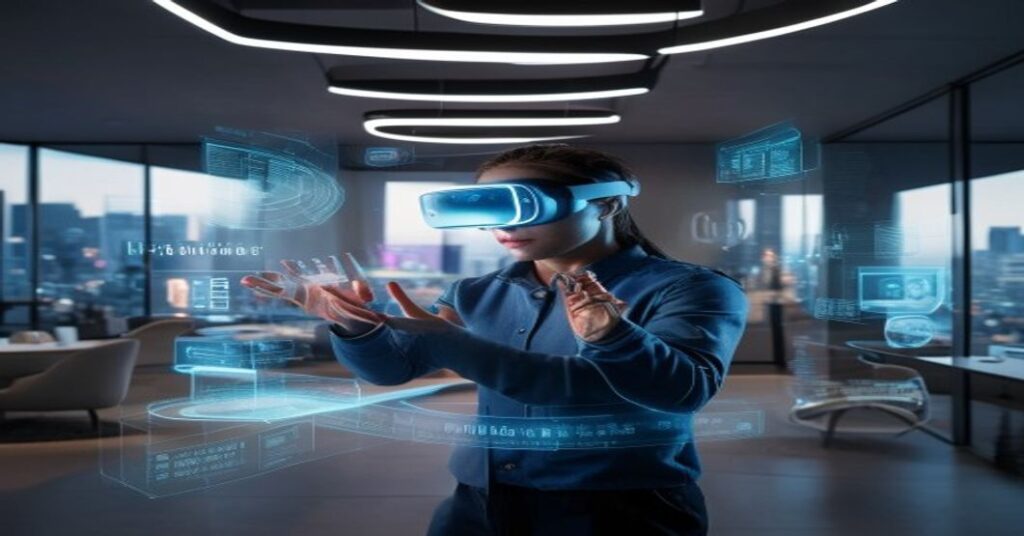

Unlocking New Realities: The Transformative Power of Augmented and Virtual Reality
For decades, the concepts of virtual and augmented realities lived primarily within the pages of science fiction. Today, these immersive technologies are not just theoretical constructs but are actively reshaping industries, redefining user experiences, and opening up entirely new dimensions of interaction. Augmented Reality (AR) and Virtual Reality (VR), often grouped under the umbrella term Extended Reality (XR), are no longer niche curiosities but essential tools poised to revolutionize everything from healthcare and education to retail and entertainment.
The Core Technologies: How AR & VR Work
While both AR and VR aim to create immersive experiences, they achieve this through fundamentally different approaches:
Augmented Reality (AR)
AR overlays digital information onto the real world, enhancing our perception of reality without completely replacing it. It allows users to see and interact with their actual environment while simultaneously viewing computer-generated elements. Key characteristics include:
- Real-time Interaction: Digital content responds to the user’s movements and environment.
- Real-world View: The primary view is the physical world, augmented by virtual objects.
- Contextual Information: AR provides relevant digital data about real-world objects or locations.
Common AR implementations range from smartphone apps (like Pokémon Go or IKEA Place) to specialized devices such as smart glasses (e.g., Microsoft HoloLens).
Virtual Reality (VR)
VR, on the other hand, creates a completely simulated environment that can be similar to or entirely different from the real world. It fully immerses the user, blocking out the physical environment and placing them inside a digital one. Essential aspects include:
- Full Immersion: Users are entirely enveloped in a computer-generated world.
- Sensory Isolation: VR headsets block out external stimuli, typically providing visual and auditory input.
- Presence: The feeling of ‘being there’ within the virtual environment is a core goal of VR.
VR experiences are typically accessed via head-mounted displays (HMDs) like Oculus Quest, HTC Vive, or PlayStation VR, which deliver stereoscopic vision and motion tracking.
Transformative Applications Across Industries
The potential for AR and VR extends far beyond gaming, offering powerful solutions across a multitude of sectors:
Healthcare & Medicine
- Surgical Training & Planning: Surgeons can practice complex procedures in a risk-free virtual environment.
- Pain Management & Therapy: VR is used to distract patients from pain during medical procedures or treat phobias and PTSD through exposure therapy.
- Anatomical Visualization: Medical students can explore human anatomy in 3D, gaining deeper insights than traditional textbooks.
Education & Training
- Immersive Learning: Students can explore historical sites, conduct virtual science experiments, or dissect virtual organisms.
- Skills Training: Industries from aviation to manufacturing use VR for hands-on, realistic training simulations without the need for expensive physical equipment or risk.
- Remote Collaboration: VR platforms enable collaborative learning and remote classrooms where participants feel present together.
Retail & E-commerce
- Virtual Try-Ons: AR apps allow customers to virtually try on clothes, makeup, or glasses.
- Product Visualization: AR helps consumers visualize furniture or appliances in their own homes before purchase, reducing returns.
- Virtual Showrooms: VR creates immersive shopping experiences, letting customers explore products in 3D, regardless of physical location.
Manufacturing & Design
- Prototyping & Design Review: Engineers and designers can visualize and interact with 3D models of products in AR/VR, identifying flaws early in the development cycle.
- Assembly & Maintenance Guidance: AR overlays instructions directly onto machinery, guiding technicians through complex assembly or repair tasks.
- Factory Layout Optimization: VR can simulate entire factory floor plans, helping optimize workflows and identify bottlenecks before physical implementation.
Entertainment & Gaming
- Next-Level Gaming: VR delivers unparalleled immersion, placing players directly within game worlds.
- Interactive Storytelling: AR/VR opens up new avenues for narrative experiences, where users are active participants rather than passive observers.
- Virtual Concerts & Events: Fans can attend live events in virtual spaces, experiencing a shared presence regardless of geographical distance.
Challenges and Considerations
Despite their immense potential, AR and VR technologies face several hurdles:
Hardware Limitations & Accessibility
High-quality VR headsets can be expensive and require powerful computing resources. AR smart glasses are still nascent, often bulky, and lack widespread adoption. Miniaturization, increased processing power, and affordability are critical for mass market penetration.
Content Creation & Development
Developing compelling, high-fidelity AR/VR content is complex, time-consuming, and requires specialized skills. The tools and pipelines are still evolving, leading to higher production costs compared to traditional media.
User Experience & Comfort
Issues like motion sickness (cybersickness), battery life, field of view, and resolution can detract from the user experience. Ergonomics and comfort for prolonged use are also ongoing challenges.
Ethical Implications & Privacy
As these technologies become more integrated into daily life, concerns around data privacy (especially with cameras and sensors constantly mapping environments), potential for addiction, and the psychological impact of blurring lines between reality and simulation will need careful consideration and regulation.
The Road Ahead: Future Trends and Potential
The future of AR/VR promises even more seamless and integrated experiences:
- Pervasive AR: AR will likely become ubiquitous through lighter, more powerful smart glasses, eventually replacing smartphones as our primary computing interface.
- Haptic Feedback: Advanced haptic technologies will enhance immersion by allowing users to ‘feel’ virtual objects and environments.
- Brain-Computer Interfaces (BCI): Early research suggests BCIs could eventually allow direct interaction with AR/VR environments, moving beyond physical controllers.
- The Metaverse: The long-term vision of a persistent, interconnected virtual world where users can socialize, work, shop, and play is heavily reliant on the maturation of VR and AR technologies.
- AI Integration: AI will play a crucial role in creating more intelligent, responsive, and adaptive virtual environments and AR overlays.
Conclusion
Augmented and Virtual Reality are far more than just technological novelties; they are foundational shifts in how humans will interact with information, each other, and the world itself. While challenges remain in hardware, content, and user adoption, the relentless pace of innovation suggests that these ‘new realities’ will soon become an indispensable part of our daily lives, transforming industries and unlocking human potential in ways we are only just beginning to imagine. The journey into the immersive future has truly just begun.